|
A Closer Look at the Role of
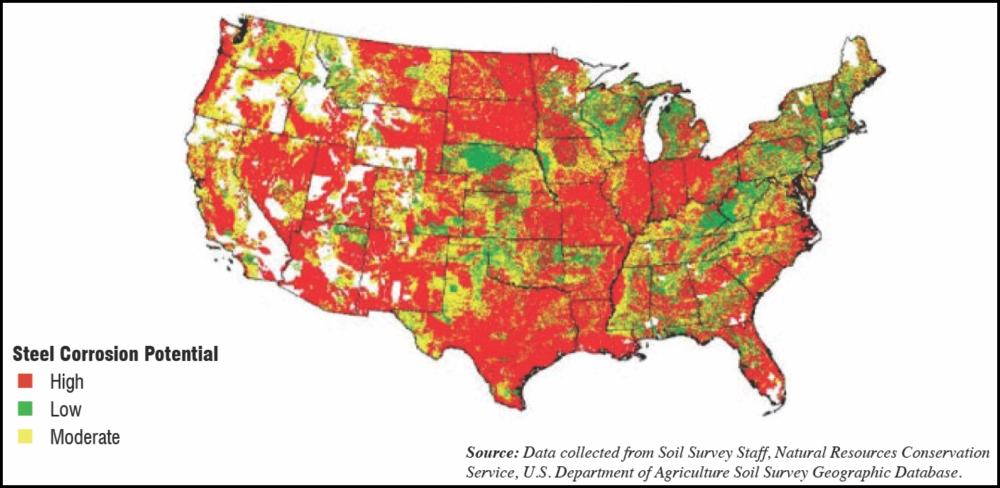
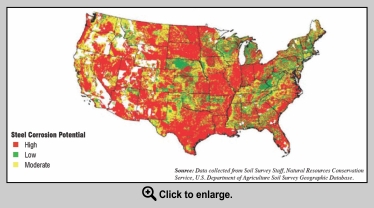
Corrosive Soils in Water Main Breaks
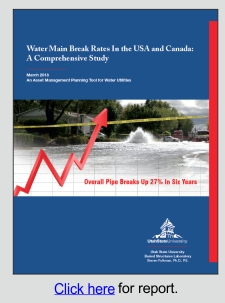
 The new report by Utah State University’s (USU) Buried Structures Laboratory on
break rates of the
most
commonly used water pipe materials titled, “Water Main Break Rates In the USA
and Canada: A Comprehensive Study,” has received a lot of attention since it was
released in March 2018. The study is being reviewed in more than 60 countries
and cites corrosive soils as a leading contributor in water main breaks.
Click
here for report. The new report by Utah State University’s (USU) Buried Structures Laboratory on
break rates of the
most
commonly used water pipe materials titled, “Water Main Break Rates In the USA
and Canada: A Comprehensive Study,” has received a lot of attention since it was
released in March 2018. The study is being reviewed in more than 60 countries
and cites corrosive soils as a leading contributor in water main breaks.
Click
here for report.
NACE’s Materials Performance
Magazine Reviews Utah State Study
An article by Ben DuBose in Materials Performance (MP) titled, “Study Examines
Corrosive Soil Conditions Behind Water Main Breaks,” has a closer look at USU’s
findings regarding the role of corrosive soils in water main breaks. Materials
Performance is the world's largest circulation journal dedicated exclusively to
corrosion prevention and control. It is published by the National Association of
Corrosion Engineers (NACE International).
Below
are excerpts from the
article:
Direct Correlation Between Soil
Corrosiveness and Break Rates of Metallic Pipes
Of utilities surveyed, 75% reported operating pipes in one or more soil areas
with moderate or highly corrosive conditions. “Utilities with a higher
percentage of iron pipe may experience a higher percentage of corrosion-related
breaks,” Folkman says. “This would especially apply to pipe installed without an
increased investment in condition assessment, pipe monitoring, and corrosion
control measures. The study found a direct correlation between soil
corrosiveness and the break rates of metallic pipes.”
According to Folkman, a cast iron pipe located in highly corrosive soil is
expected to have over 20 times the break rate of a similar pipe in low corrosive
soil. “Traditionally, the thickness of the iron pipe wall provided the
additional corrosion protection,” he writes. “[Cast iron] pipes manufactured
after World War II have significantly higher failure rates due to thinner walls.
The resulting higher breaks with iron pipes due to corrosive soils is consistent
with other research and studies.”
Meanwhile, ductile iron pipe in highly corrosive soil has over 10 times the
break rate relative to low corrosive soil. “Because the wall thickness of
[ductile iron] pipe has decreased over time, internal and external corrosion are
a bigger concern for this pipe product,” Folkman says.
Corrosion Prevention Methods Used by
Utilities Often Ineffective
The survey found that 80% of respondents reported using at least some form of
corrosion protection. In order, the top five most common preventive methods used
by water main operators are polywrap; anodes or cathodic protection; V-bio
polywrap; impressed current; and dielectric coatings.
However,
Folkman cautions that many water utilities often do not know the specific cause
of external corrosion observed on their water mains. Consequently, the chosen
preventive measure may not work effectively. “For example, it is not effective
to install an anode on a main that has a bacteriological corrosion problem,” he
says. “Similarly, an anode bag installed to reduce corrosion caused by a stray
impressed current would be quickly used up and would provide only short-term
protection. Also, polywrap does not protect a pipe from all corrosion types and
may get damaged during the installation.”
Municipalities Urged to Consider
Using More PVC Pipe Which Has Lowest Failure Rate
As a result, Folkman urges water main operators to
consider more PVC pipes, which had the lowest overall failure rates in both the
2012 and 2018 surveys. “PVC is not subject to corrosion, unlike ferrous and
concrete steel cylinder pipes,” he explains. Folkman says water main operators
are gradually moving in the direction of PVC, with 74% of utilities allowing its
use in 2018 - up from 60% in 2012. “A lower failure rate contributes to a lower
total cost of ownership,” he says in addressing cost concerns.
|
Regards,
Bruce Hollands
Executive
Director | Uni-Bell PVC Pipe Association
2711 LBJ Freeway, Suite
1000 | Dallas, TX 75234
T. 972.243.3902 ext. 1019 | F.
972.243.3907
www.uni-bell.org
  
|
|
|